This week’s coffee update: good flat whites can be had in Doha.
Now, onto something a little less comfortable:
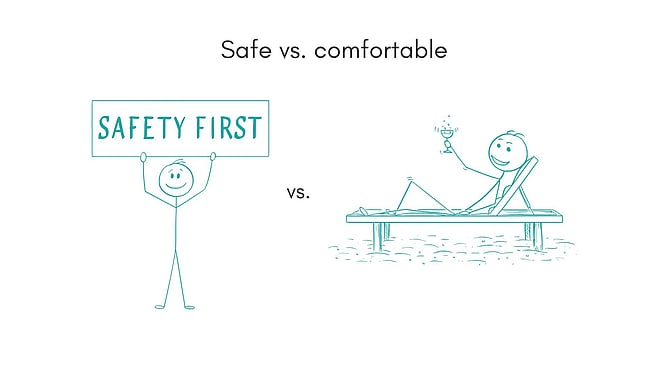
Feeling safe is not the same as feeling comfortable. And if you work in a team, that distinction matters.
If you are remotely interested in leadership, or have spent any time on LinkedIn in the last ten years, you will have come across psychological safety.
Important concept but a bit of a mouthful.
In practice, it comes down to this: can I ask a question, admit a mistake or disagree with someone without worrying that I will be humiliated or that it will be held against me? And, importantly, without fearing that it will damage the relationship.
Even if that someone is the person in charge? Maybe especially then.
Amy Edmondson’s research helped establish why this matters for teams. In her early work in hospitals, she found something that initially seemed rather unhelpful: the teams with better teamwork appeared to make more mistakes.
This raised an obvious question: What is going on here?
Upon closer inspection, it turned out, these teams were more willing to report mistakes. In teams where speaking up felt riskier, more mistakes stayed hidden. And with that, remained unaddressed and continued to happen.
This is one of the reasons why I am a little suspicious when teams tell me, ‘We get along great, we never disagree, we all like each other, etc.’ While some of this may be true, it likely also points to the fact that at least some people do not feel safe to disagree, with you or with each other. It is almost like your first goal needs to be for more people to disagree with each other. Constructively.
But here is the bit I want to get to: being able to speak up does not mean that doing so feels comfortable.
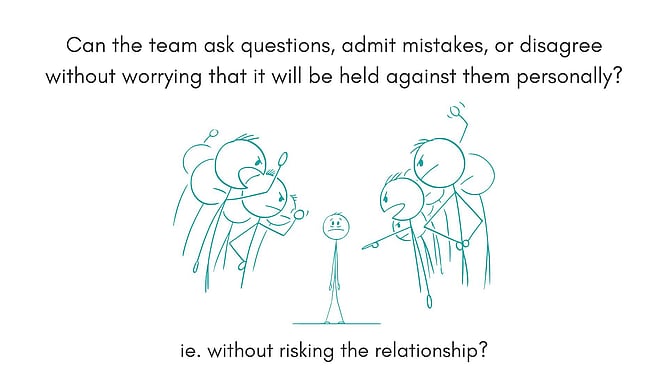
Admitting you got something wrong can be uncomfortable. Telling a teammate that their behaviour is making your work harder can be very uncomfortable. Hearing that feedback yourself? Also not really anyone’s favourite.
But these conversations are essential for growth. They are also essential for performance.
This is a conversation I have often: I have never been in a high-performing team, worked with a high-performing team, or coached a high-performing team that did not have tension. High-performance needs tension. If there are never any disagreements and if there is never any tension, you are not close enough to the edge. And you are not pushing for performance.
Often this tension arises when differing perspectives are shared, when uncomfortable feedback is given and when ways to improve what's not working are thoroughly discussed.
Psychological safety created room for those conversations.
So, how do we build it?
In my almost eight years of teaching, and throughout my time working in high-performance sport, this concept was at the core of what I did every day. Yet I rarely used the term with students or athletes.
Too abstract. And generally not what someone needs to hear when they are already struggling with something.
But creating an environment where they could ask for help, try something, get it wrong and try again? That was the work.
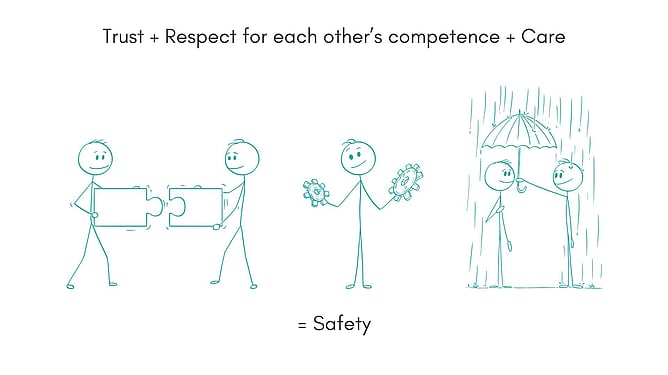
When I work with teams now, there are three ingredients I look for:
1. Trust
Do you do what you say you will do? Are you honest when you cannot? Can you admit that you got something wrong? And what happens when somebody else does? How do you react?
If I ask you to speak openly and then become defensive the moment you do, you have learnt something about how safe it is to be honest with me. Whatever I might have said beforehand.
Are you reliable? Can you give credit to other people? Are you transparent? Will you listen, and do you actually hear what's being said?
Trust is built in the small things and small behaviours. Repeatedly. Building trust takes time. Giving someone a reason to doubt it can be considerably quicker.
2. Respect for each other’s competence
In my day-to-day work, I coach newly matched founding teams. We bring scientists and entrepreneurs together, which means bringing together people who know a lot about very different things.
They need to meet at eye level.
That may sound straightforward until someone asks you what, to you, feels like a very basic question. Their lack of knowledge in your area of expertise does not cancel out their expertise in theirs.
The same is true in sports teams. Athletes often compete for weeks, sometimes months, for a spot on the same team. And when they get selected, those who were opponents for months now have to become a team. Here, too, it can be helpful to figure out where exactly each athlete’s competence is - and respect that. Even when playing the same sport, athletes have different strengths and make different contributions to the team based on that.
Respect needs to show up in what you actually do: whose advice you seek (and whether or how you then take that advice), whose judgement you trust, and whether someone has the authority to make decisions in the area you brought them into the team for.
Saying you value their expertise and then overruling them every time is going to make that message a little difficult to believe. At the same time, you probably don't need to take all advice you're ever given.
3. Care for the person
You do not need to share your innermost thoughts with every teammate. Or become best friends. But you do need to recognise that the person working alongside you has a whole life beyond what you see. Family. Health. Money worries. A parent who needs more support. A child who has apparently decided that sleep is optional. That they have a friend who struggles. Or a cat that's missing.
All of that comes to work or to training with them. Just as your life comes with you.
Understanding this does not remove expectations or responsibility. It is also not an excuse. It helps you have better conversations about what is happening and what is needed.
Care and accountability can sit quite comfortably together.
Which brings us back to discomfort.
When these foundations are there, a team can have a difficult conversation without every disagreement becoming a threat to someone’s place in the team. We can question a decision, say that something is not working and admit that we need help.
And we can stay in the conversation long enough to figure out what needs figuring out.
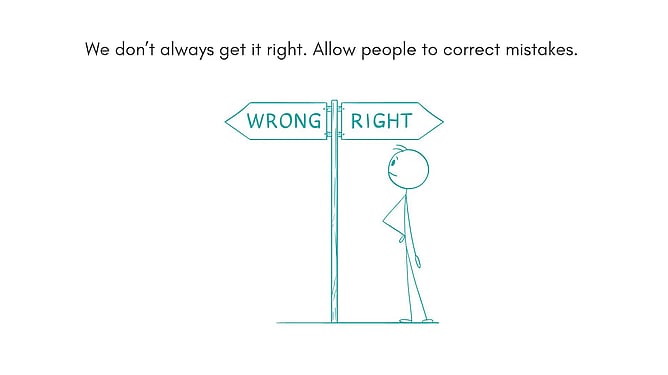
That also takes a little generosity. People will not always find the right words. Sometimes feedback will land badly. Sometimes we will need to say, “That came out wrong. Let me try again.”
It means making room for repair, while still addressing what happened.
Over time, teams can grow closer through these conversations. They learn that a disagreement can be worked through. That honesty can help. That the relationship can hold when something difficult needs saying.
And the next conversation becomes a little more possible.
So, when you hesitate to raise something difficult next time, ask yourself, 'Is it really not safe? Or does it simply not feel comfortable?'
If it’s not safe, what can you do to build trust, extend respect, and show care to ultimately contribute to making it safer?
If it is actually safe, but it will be uncomfortable, step forward! Into the uncomfortable and see what happens.
Confidence comes from evidence. And with every step into the uncomfortable, you generate evidence for yourself that you can do it - and for your team that they can do it too.
Thanks for taking the time to read this week’s edition of the blog. And thanks also to those of you who make me feel safe enough to disagree, admit mistakes, and voice a different point of view. You know who you are :). I appreciate you immensely.
Key points:
Safety is built through everyday behaviour, including how we respond when someone disagrees or admits a mistake.
Care and accountability belong together. We can understand someone’s circumstances and still address what needs to change.
High-performance teams need tension - step into the uncomfortable, raise what needs to be raised to help everyone improve.
Reflection Questions:
When have you avoided a hard conversation because it felt uncomfortable?
When have you made it unsafe for someone else to raise something that needed to be raised? (We all do this sometimes.) What would you do differently next time?
Where do you say you are trusting and respecting someone’s expertise, but you struggle to act accordingly?

