It’s been a while - thanks for still being here. Many coffees have been had since the last blog, and many were very good. Some time in early October, I got one with a latte-art Santa (see picture) - and while I admired the craft, it did feel a bit early for a Christmas theme. I sent a picture of it to a friend, and the next time I saw them, they handed me a cup of coffee with the words, ‘I drew a Santa for you…’ You decide which one you like best! I know which one still makes me laugh.
I have been busy preparing for all sorts of things, and if this blog were to be a true reflection of my last few weeks, it would be all about that preparation - but that will have to be the next one ;)
Back to standards…
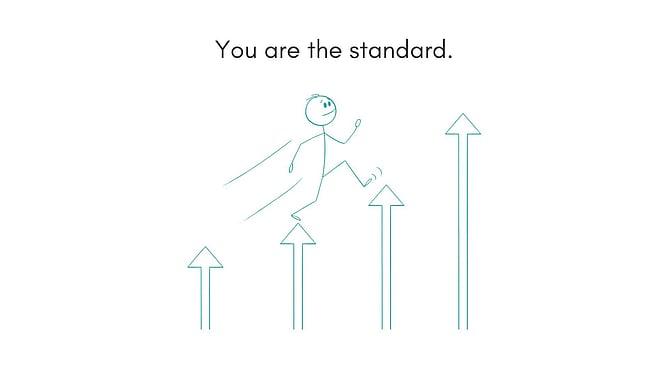
If you are a leader, you set the standard whether you intend to or not.
Remember to think of leadership beyond formal or professional roles. Whether you are a parent, a sibling, a friend or a colleague with particular expertise, chances are that in at least one area of your life people look to you for leadership. They look at what you do and how you do it. And that influences what they do.
In a more formal setting, most teams and organisations talk about standards, but what really guides them are rules or policies. Leading by and running on rules is inherently less effective than doing it by setting standards.
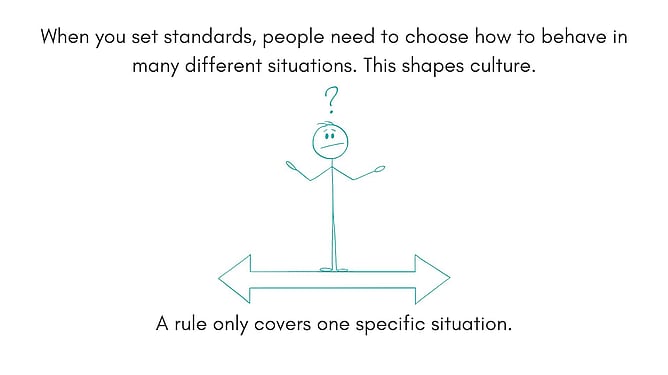
Rules can be broken. Rules are black and white. Rules need to be clear for every single situation. Rules say:
This is what you can do.
This is what you can’t do.
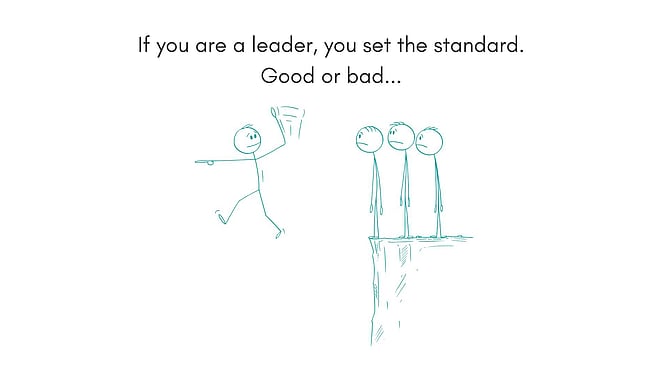
Standards are different. A standard says: This is who we are. And if you are one of us, this is who you are. And therefore, this is how you behave. Standards need people to think and decide what to do (and what not to do). Standards communicate how people are expected to behave generally. Regardless of whether anyone is actually watching.
A simple example to illustrate the difference:
Rule: Be on time. → This says, do this one thing: Don’t be late.
Compare this to a standard:
Standard: We respect each other’s time. → This says, ‘act accordingly’, in all contexts.
It goes beyond being on time to meetings. If I respect your time, I won’t bother you with questions I can answer myself; I won’t ask for your feedback on a draft until I have got it to decent enough quality for it to be worth your time, thoughts and energy. I won’t ask for a meeting in the first place if it is not necessary. At the same time, I will absolutely ask for help right now if I am unsure and might get off track without your support - aligning now might protect hours of your or our time correcting an avoidable mistake later.
So, rules create compliance (or a lack of it).
Standards create culture.
Standards are not the words or values on the wall; they are how we do things, what people do and what they walk past, what leaders (and all others) are willing to tolerate and what they call out.
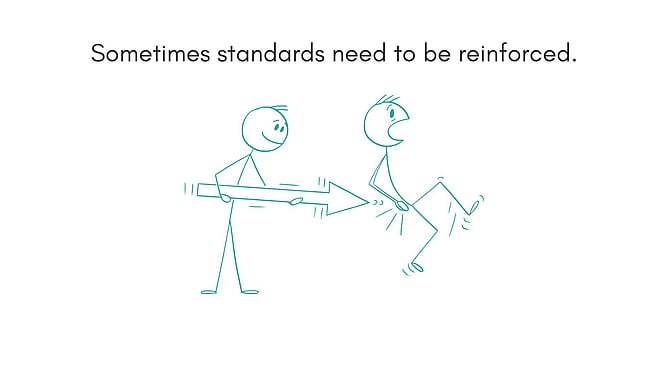
Standards allow people to take ownership - and at times, standards need to be reinforced. You can’t have people consistently underperform with no consequences. If you allow this, you lower the standard for everyone.
Policies, rule books, and other documents are not what create a standard.
Behaviour is.
Start with a simple question:
How do we want to behave when no one is watching?
No teammates, no colleagues, no leaders or managers, no clients, no stakeholders. No one. What you do when no one is watching will eventually show when everyone is watching.
And it continues with more fundamental questions: What do we want to be known for? And how do we want to be remembered? (when we leave the room or when we die… )
You can’t turn a standard on and off - the true standard always comes out. And people will know. You can’t fake a standard.
Perhaps now is a good moment for you to think about what standards you hold yourself and the people around you to. Are they the same? Do you hold others to a higher standard than yourself? Do you hold yourself to a higher standard than others? Take a minute to consider this in the context of your friendships, relationships, work, your sports team, etc.
I often speak with emerging founding teams about this because the standards they set for themselves, for their work, and for their relationships will fundamentally shape the company and its culture. Most would not explicitly discuss this if it wasn’t prompted. But like many things, we can be deliberate about the standards we set.
High standards can be hard to reach. That means that sometimes you won’t meet your own or your team’s standards. That is ok. There has to be room to get it wrong. Allowing mistakes and supporting someone to meet the standard next time is different to lowering a standard.
I quite like the approach former All Blacks coach Steve Hanson has shared in numerous interviews: ‘If you can’t change the man, change the man.’ Meaning, in his case, if a player doesn’t meet your standards, you support them to change their behaviour; you give feedback and guidance on what the expectations are and what ‘good’ looks like. You give them time to work on it; time to get better. You help them change their behaviour. But if they do not make changes and they continue to not meet the standard, you need to replace them with a different player.
This applies in many contexts. Sports teams, of course, but also founding or work teams. It is also possible in your friendship circle.
With athletes, we often talk about above-the-line behaviour and below-the-line behaviour. What is acceptable, what is not.
Above-the-line behaviour is characterised by people taking ownership, accountability and responsibility for their behaviour and their performance. Below-the-line behaviour is shaped by blame, excuses and denial.
It is a good analogy for rowers, because above the line sits the acronym OAR = take Ownership. Be Accountable. Be Responsible.
Below the line sits the acronym BED = Blame others. Make Excuses. Be in Denial.
Every day, rowers (and everyone else) have a choice:
Pick up your OAR and go rowing or go back to BED. → Over time, only one of them builds high performance.
It means owning your mistakes, correcting them, asking for help when you need it. It means supporting each other. It means holding each other accountable. It means focusing on improving, rather than pointing fingers at those who made mistakes.
People, teams, groups, organisations, etc., with high standards take ownership; they are accountable, and they take responsibility. Individually and as a group or team.
Above-the-line behaviour.
Simple. Not easy.
Thanks for taking the time to read it :) I appreciate you.
Key points:
Rules create compliance (or not). Standards create culture.
Behaviour drives standards more than words ever could.
First, try to help people meet your standard by helping them rise to what is expected, not by lowering the bar. Only when they truly can’t replace the person.
Reflective questions:
What standards do you hold yourself to?
What standards do you hold others to? (is that fair?)
Which standard do you struggle the most with?

