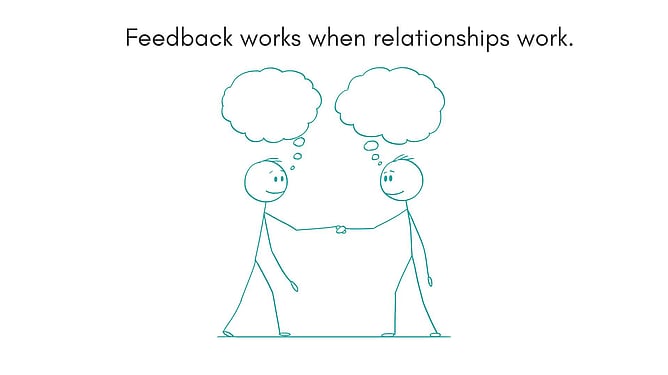
If you want performance, you need feedback. You don’t need a feedback framework… Or at the very least, that is not the first thing you need. Instead, you need strong relationships with the people you want to give feedback to.
But before we go into that, a brief update on coffees consumed this weekend: 2.
Good coffees consumed this weekend: 0.
Sad times. But it could be worse… IYKYK.
On the bright side, both coffees were had in either a beautiful or an interesting location, so there is that.
Anyway, back to feedback. Feedback is essential for performance. It is essential to improve. But it is also essential to stay at a certain level. That is right: it is not only about improving, it is also about reinforcing what is currently working, so the other person knows what to keep doing.
We often skip this.
Just to recap:
If you want performance, you need feedback.
Simple. Not easy.
We know from research that positive feedback always works. Yes, there are nuances to this. It is, for example, more helpful for performance when you give positive feedback on the action, work, or behaviour the person had control over. This means, rather than vaguely saying, ‘Well done!’ or ‘Good job,’ you comment more specifically, ‘The way you did XYZ works well because… and it really made a difference to ABC.’ But regardless of whether you are specific or vague, positive feedback always works in the sense that it has a positive impact on performance.
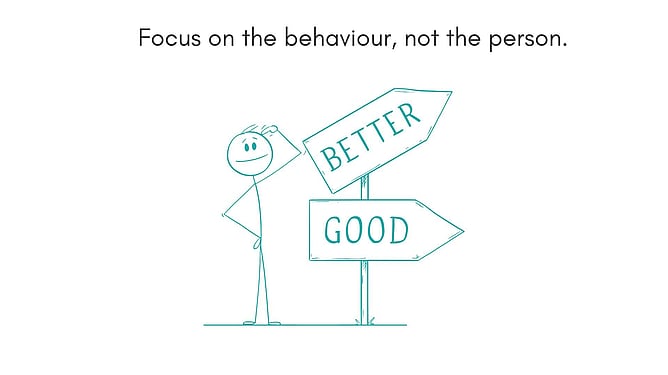
A few weeks ago, I had the chance to work with a group of leaders. The first question I asked them was, ‘Are you giving the positive feedback you could be giving right now to reinforce good performance of your team?’
Silence in the room. A few shook their heads.
This is a pretty normal reaction, because we still think we don’t need to talk about things that are working. But this is important.
Athletes know this. Sports coaches know this. When you are working on movement, small changes can feel monumental. This also means that athletes feel like they are making a big change when it is barely noticeable from the outside. And so coaches get them to exaggerate movements. Coaches will use phrases like, ‘Remember this feeling,’ ‘Keep doing this,’ or ‘Yeah, now copy & paste that movement.’ In short: they give positive feedback. They tell the athletes what they are doing well and what they should keep doing.
This enables athletes to keep performing at a high level rather than slipping back to a mediocre level. To ensure that good performance, desirable behaviour and useful actions are consistently maintained, you need to give positive feedback.
Step 1: Give all the positive feedback you could be giving right now.
Negative feedback is more challenging. Not only to give. It is also much more difficult to get it to land.
Research does tell us that negative feedback is really only effective when the relationship between the person giving the feedback and the person receiving it is strong. Feedback is received in the context of the relationship between people. This means it is also received in the context of the relationship history. The stronger the relationship and the more trust and safety there is between people, the more likely it is that feedback will be taken and implemented.
Step 2: Build the relationships that allow you to give negative feedback.
This is particularly important to know and remember if you are in a leading role somewhere. By this, I don’t just mean a formal leadership role, but any context where you are leading. Most of us are leading in some sort of space in our lives, whether this is in your family as a parent, a sibling, an aunt or uncle, within your friend-group, among colleagues, etc.
Wherever you are in a leading role, people watch what you do with feedback. How do you act when you receive feedback? Do you get defensive, do you shut down, do you receive the feedback, and, importantly, do you change your behaviour?
The reactions above - getting defensive, shutting down, etc. can be normal. What is interesting is what you do after your first reaction. What is your response to feedback? Do you listen to it, consider it, decide whether you want to accept or discard it, or do you start arguing? Do you start your response with, ‘Yeah, but…’ indicating that you have not listened and that the feedback has not landed?
I asked the group of leaders this: When was the last time your team saw you receive feedback? When was the last time they saw you change your behaviour after receiving feedback?
In the spaces where you lead, how you take feedback determines whether you will get more feedback, what kind of feedback you will get and whether people will ultimately listen to your feedback.
Honest, constructive, negative feedback is part of building strong relationships.
Ideally, feedback says, I see what you are doing, I know you want to perform well, I think you can do better, and here is how I think you can do better. I am here to support you, and I have high expectations of you. What you are doing right now is not your best.
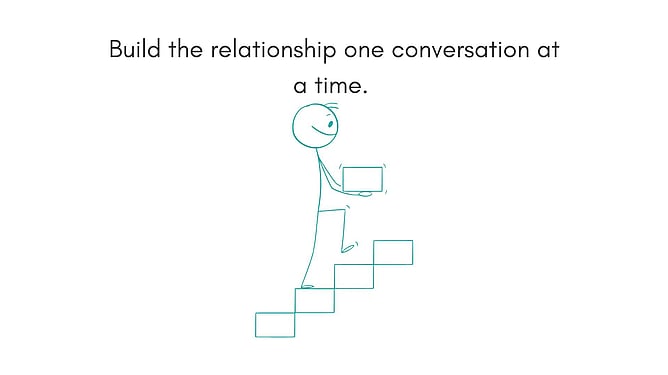
Notice how the focus remains on the behaviour, on the actions, not on the person. This is essential to build and maintain trust and connection. Feedback is about helping someone else do better than they currently are; it is not about changing their personality or who they are at their core.
Whether negative feedback is heard and acted upon depends on the quality of the relationship between people exchanging the feedback. This is why it is worth investing in relationships. Every interaction you have with someone is an opportunity to build that relationship. I often use the phrase ‘The conversation is the relationship’. This is true for feedback conversations, too.
Negative feedback, delivered in a strong relationship, with a focus on the behaviour, not the person, will likely not only land, but it will prompt a behaviour change, and it will further strengthen the relationship between the people.
Many of the deep-tech founding teams I work with initially hesitate to give each other honest negative feedback, especially if they are new as a team. Usually, their thinking falls somewhere along the lines of… ‘I need to wait until things are more stable, until the relationship is better, until this fundraising round is done, until <insert some other relatively random reason or timeframe to put off giving real feedback>.’ This is often a way to avoid the conversation that needs to happen, and the silence actually does more damage than a hard conversation would have.
If you find yourself in a situation like this, remember that feedback conversations also contribute to building relationships. Every conversation you have is an opportunity to shape the relationship in the way you want it to develop. Make use of it.
To me, there are very few things that are a bigger compliment than someone saying, I see you, I see that you are trying to get really good at this, I think you can do a couple of things better, and I am willing to get a little uncomfortable (because, let’s be honest, giving negative feedback is not always easy or enjoyable). At the same time, I share with you what I think you can do better.
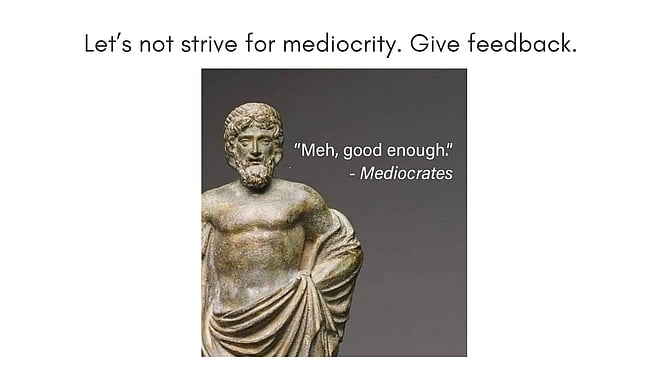
Instead of striving for mediocrity… you start aiming a bit higher.
If the relationship is strong, you will feel supported.
If the relationship is strong, you will see a change in the person's behaviour.
If the relationship is strong, you will adjust your behaviour when receiving negative feedback.
A quick note on timing: Give feedback before it is too late. Often, in work contexts, we give feedback at the end of a project, when all the work is done, and nothing can be changed.
This is silly.
Give feedback when it can still have impact; when the outcome can still be influenced.
Athletes know this. They operate in feedback-dense environments because changes need to be made before it is too late. If they get to a major competition, finish fourth, and their coach tells them afterwards, ‘well, that wasn’t good enough,’ they’ll say… ‘Yeah… no shit Sherlock…’ (excuse the language … but they may word it even more strongly), because at that point it is too late.
Feedback must be delivered before it is too late.
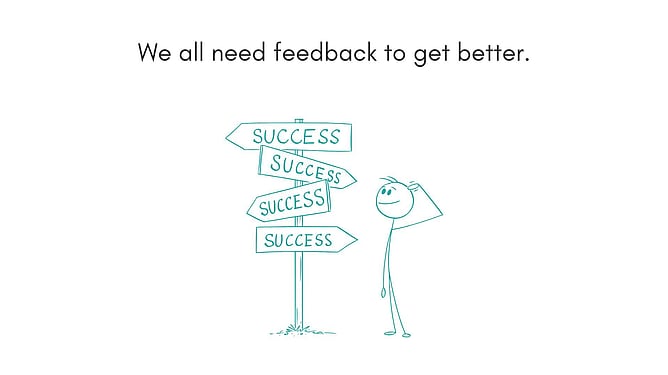
With negative or constructive feedback, I find it useful to see if there is a pattern. So rather than commenting or giving feedback on something I have noticed once, I will usually give negative feedback on behaviours that have occurred more than once. Equally, I appreciate when people point out what I can improve and work on, especially if it is a pattern … granted, like everyone hearing negative feedback, I may not love to hear it in the first moment. But I usually appreciate it, especially if we have a strong relationship.
If I think a person I truly trust has a point, I will work to change my behaviour. I may not get it right straight away, but I will work on it.
And whenever I give feedback to someone I trust, they can be sure it is with the best intentions and that I am willing to be patient for them to work out how they want to implement the feedback. Because sometimes this takes a few attempts. What I can say is that giving feedback, seeing someone genuinely consider it and then seeing their behaviour changing increases both the trust I place in them and the respect I have for them.
So there is that. :)
Giving and receiving feedback is like any skill. It needs regular practice and that also means you may get it wrong a couple of times. That is fine. We are all here figuring it out.
So, to those of you who have helped me and continue to help me grow with the feedback you give me, thank you! And to those of you whom I have given feedback to and who have taken it, thank you, too. I appreciate you & our relationship. ;)
Talk soon!
Key points:
Positive feedback always works.
Negative feedback only really works when the relationship is strong.
Give feedback early enough and throughout the process, when the outcome can still be influenced and when things can still be changed.
Reflective questions:
What positive feedback could you give this week?
When was the last time you received negative feedback and actually changed your behaviour? (Who gave the feedback? How did the relationship with them influence how you took the feedback?)
Who do you need a better relationship with so that they are more likely to listen and act on feedback from you? And maybe also so you accept feedback from them?

