I got distracted every time I tried to write this post. The irony is not lost on me.
The coffee looks better than it tastes - a common occurrence these days - though admittedly I get extra excited when it tastes better than it looks.
But I'm getting distracted again… This blog is meant to be about focus, or better, on figuring out what you need to focus. And about building a system that makes it more likely to occur.
I, for one, can not concentrate for long periods of time in complete silence. I can't do it. Actually, there is one exception: while running or hiking. I have excellent focus then and often do my best work while out on a run or a hike.
This poses some very obvious practical challenges.
It is, for example, very difficult to coach people while running, unless of course, they're running with you. Because I coach mostly online these days, that is quite rare. Thinking, however, can be done while being out for a run. Whenever I have tried to figure something out for too long and not found a solution, it is usually time to go for a run. That is what it takes to figure out what to do next.
There is something meditative about endurance training. Same automated movement. Regular heartbeat. I think the consistency makes it more likely for me to get into flow.
I also enjoy working at cafes. It’s a block of time, usually an hour to two hours. The white noise of the coffee machines and the chatter of people in the background allow me to focus for that period of time. The same is true for trains. I am often more productive on trains - again, a bit of noise, no distractions, no escape. And a limited amount of time available to get the work done. Perfect.
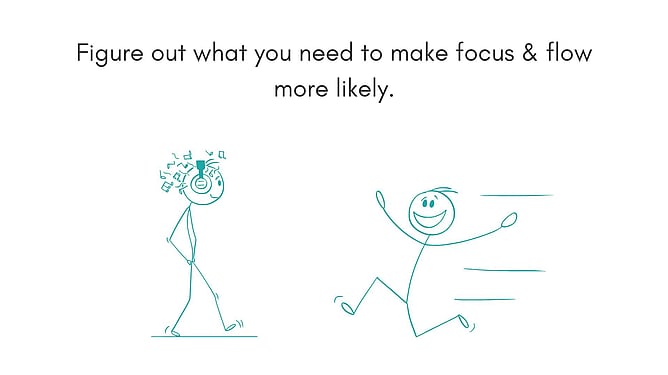
So we have a few criteria that help generate focus already:
A time limit
Indistinct background noise
Fresh air
Movement
Reduced options
Interestingly, I've always worked like this. Periods of focused attention followed by phases of mental recovery or work that require less focus or concentration. (I like to call this work ‘administrivia’.) While training, there were sessions that required more intense technical focus than others. Sometimes, thinking of something completely different was actually more useful than intense focus on the task at hand.
In rowing, you need to let go. The less you try to, the more control you actually have over the boat, its speed, its balance, and its run. Counterintuitive, but true in other areas of life, too, I think.
But focus doesn’t just matter in the moment. It is also about planning and deciding what is important ahead of time.
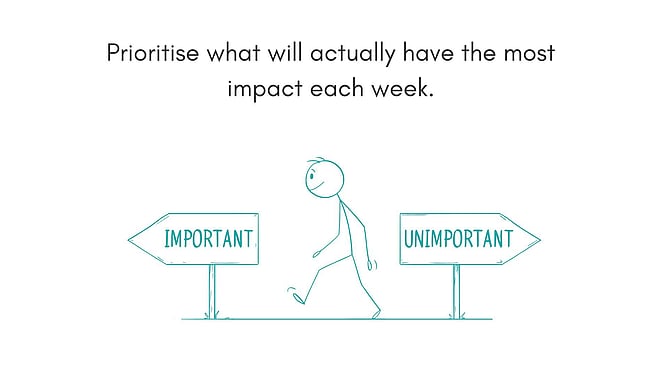
I worked with an athlete once, who, after years of competing at international level, said, 'There are usually two sessions a week that really matter. Maximum three. And now I make sure I show up for those.'
Her usual training week would have had somewhere between 10-15 sessions - and, just to be clear, she did all those sessions, but she made sure she was fully prepared and switched on focus-wise for those. Even during her worst weeks.
During her best weeks, she'd naturally have this level of presence and engagement for more than just two or three sessions. But when planning, she identified which sessions mattered most that week - so when things became challenging, she knew where to place her focus, where the biggest impact would be.
You can do this.
What are the one or two activities this week that, if done well, really move the needle? What really makes a difference or an impact? What will contribute to meaningful progress? Usually, there are two or three things; everything else is noise. That doesn't mean you don't aim to do the other stuff well. In fact, if you have the capacity, go ahead. But if you don’t, what are the two things that need to be done well?
It might be a workout. It might be a chat with a family member who needs your support right now or a friend whom you want to reconnect with. It might be being fully present in a relationship you’re building or rebuilding. It might be preparing for a work task that you want to get right.
Going into this and aiming to do it with full focus doesn’t only mean you apply yourself as best as you can in the moment. It means making sure that you give yourself the best possible chance to do that thing successfully. This is also why it is important to identify ahead of time where your biggest levers are for that week.
Once you have, you can ask yourself: What do you need to do to get yourself into the best possible position to actually do this well? In other words, what do you need to do to show up well at that moment? What preparation is needed?
Sleep well?
Plan & prepare?
Practise?
Eat well & drink enough water?
Reflect?
Rest?
Connect with someone?
Once you start paying attention to what actually helps you focus, you can be more deliberate about setting yourself up for it. And yes, you can time-block your calendar if that helps you. But the block itself is unlikely to be enough to actually allow your brain to get into focus mode. It’s a blunt tool by itself.
In the time I’ve spent thinking about and writing this today, I have gotten distracted several times, listening to conversations of other people around me, reading a message from someone I work with at the moment, and thinking about useful quotes, because this morning, I was talking to a friend who is looking for some useful quotes. And apart from a couple of my go-tos, the only one I could remember this one from a book I read recently:
‘Wandern ist Spazierengehen mit Essen im Rucksack.’^
When I first read it, it made me laugh.
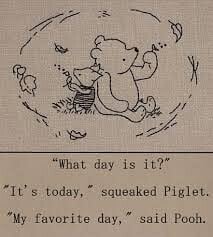
It translates to ‘Hiking is going for a stroll with food in your backpack.’ Not the kind of quote that was useful for my friend, but here we are. Distraction is often not useful. While writing this, I remembered the quote from Winnie the Pooh in the image above.
Perhaps a more useful? But the point is, I got distracted. And getting back on track is pretty difficult. But we had also talked about this post and laughed about me getting too distracted to finish the piece on focus. Now that they knew, too, I am all of a sudden more accountable to finish it…
I work with newly formed founding teams. They often forget that they are a massive support asset to each other beyond the actual work everyone is contributing to the shared venture. They provide accountability. Beyond what you can put in place for yourself, teams can use each other to create the conditions for better focus.
It may be working together in the same space at the same time. It may be agreeing on time lines and creating accountability to checking in on progress. It might be calling each other out. It might be supporting each other in planning and preparing to make sure the things that deserve full focus this week, get it.
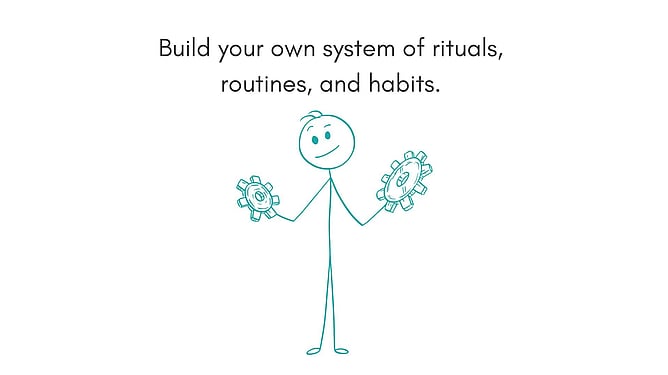
Don't rely only on willpower to establish focus. You will lose that battle. - Rely on a system that you build. Rituals, routines, and habits are your system. Identifying what needs focus each week can become a routine. Preparing the space, gathering your resources, and blocking the time are rituals to enable focus. Ensuring enough sleep, water or movement to enable focus becomes a habit. As do enough rest and solid reflection, if you choose to practise those intentionally.
Focus is not magic. It’s a system. One you have to choose to build and one you have to choose to use.
Oh, and when you lose focus, remember that you can always begin again.
Ps. There is another Winnie quote I like:
‘Any day spent with you is my favourite day. So today is my new favourite day.’
It made me think of days that I got to spend with people who matter to me. Made these days some of my favourites. :) Thx.
Till next time.
Key points:
We all get distracted from time to time.
Understanding what you need to focus can help you design a system to make sustained focus & flow more likely.
Friends or teammates who hold you accountable can really help.
Reflective questions:
What distracts you most often?
What makes focus more likely for you?
Is your system to enable focus currently working well, or does it need some attention?

