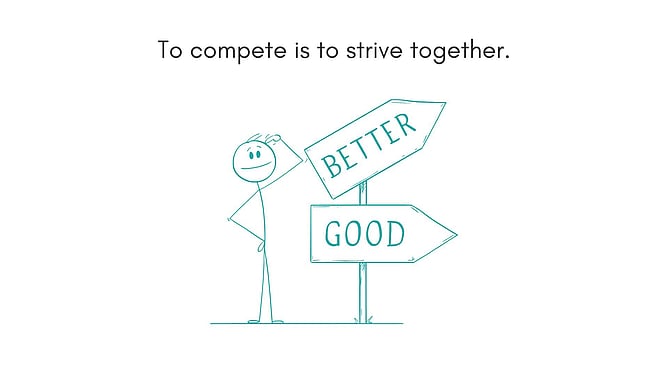
Or at least it should be.
Let’s take a quick weekend trip into etymology together: the word compete comes from the Latin competere, combining com (together) and petere (to seek, strive for, or aim at).
If we were true to the word's roots, to compete would mean to strive together.
Over time, the meaning shifted toward rivalry. Today, we usually think of competition as trying to beat someone else.
The interesting thing is that striving together is exactly what high-performance teams do.
And too much internal competition is exactly what prevents teams from becoming, and staying, high performing.
High-performance teams compete externally, not internally
One of the biggest misconceptions about high performance is that teammates should compete against one another. All the time.
On the surface, internal competition seems beneficial. It creates urgency, pushes people to perform, and rewards top contributors.
But over time, this creates the opposite effect. People start working against each other instead of with each other.
Information gets hoarded and withheld. Individual credit becomes more important than collective results. How you are perceived starts to matter more than the quality of your work. People focus on winning individually rather than helping the team succeed. They become more concerned with looking like a high performer than actually becoming one.
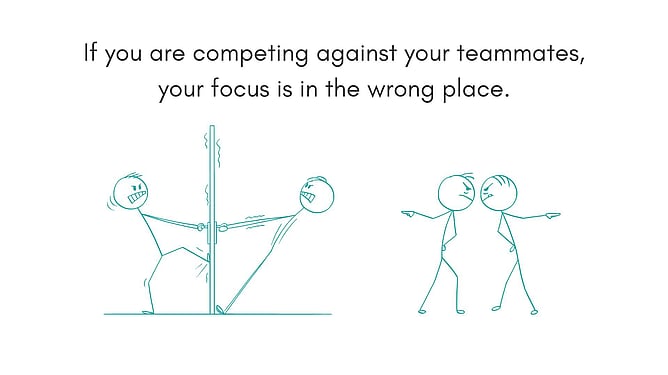
This is why high-performance sports teams keep internal competition contained.
Athletes compete fiercely during selection periods because the goal is to identify the strongest team. But even then, the best athletes understand that helping their teammates perform well improves their own chances of selection, and with that, of success.
The more experienced the athlete, the more likely they are to bring out the best in those around them.
They understand a simple truth: your teammates' success enables your success.
A team of the strongest individual players does not automatically become the best team. In fact, being overly competitive with your teammates can become a disadvantage. A costly one.
Once selection is complete, the competition doesn't disappear. It simply moves outside the team.
The focus shifts from competing against teammates to competing against opponents.
Many workplace teams never make that shift.
Instead, they spend valuable time and energy competing internally. By trying to outperform the person next to them, they take their eyes off the actual goal.
Many founding teams get trapped in this, too. Some never recover. I see it, from time to time, in the startup teams I coach: co-founders compete against each other, they compare (explicitly or implicitly) who has worked what number of (ridiculous) hours, who has contributed what expertise; they fight, sometimes openly, more often covertly, over whose expertise is more valuable. Sometimes founders get stuck believing their own contribution is the most important, and they try to quantify whose contributions had the greater impact on the business.
This might start as friendly competition, but it almost always turns sour eventually.
In the end, everyone loses.
Each co-founder loses, the start-up loses, and the real problem they are trying to solve gets forgotten about: everyone who could have benefited from that solution also loses.
A lose-lose-lose scenario.
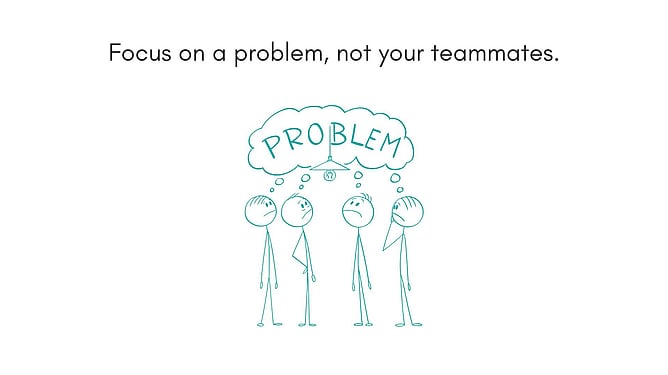
High-performance teams operate differently.
They understand that the goal is not me vs. you.
The goal is us vs. the problem.
The problem might be a technical bottleneck, an ambitious target, a demanding stakeholder or customer, an external competitor, or a difficult business challenge. Whatever it is, everyone is focused on solving it together rather than competing for individual recognition.
This mindset changes behaviour.
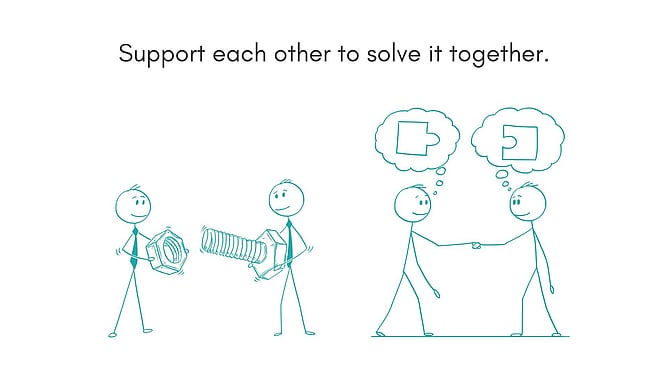
People share knowledge more freely because helping a teammate helps the team. They seek to better understand each other's strengths because those strengths can contribute to solving the problem. They challenge ideas without attacking people. They celebrate collective wins instead of protecting personal territory.
Most importantly, they recognise that teammates are assets, not obstacles. They ask each other for help. They respect each other’s competence without putting anyone on a pedestal.
If you want to know whether a team is competing internally, look for the warning signs.
Are people more concerned with credit than outcomes?
Do individuals or departments blame each other when things go wrong? Do they make excuses?
Is information withheld rather than shared?
These are some of the early signs that competitive energy is being directed inward.
The highest-performing teams direct that energy outward. They compete against the challenge, the problem, or the standard they are trying to achieve.
Competition itself is not the problem.
The direction of competition matters.
When competition points inward, teammates become opponents. Over time, this destroys teams.
When competition points outward, teammates become allies. Over time, this helps teams rise.
And that is where real high performance begins.
Because that is how you strive together.
'Till next time. And thank you for taking the time to read it all. :) I appreciate it & I appreciate you.
Key points:
High-performance teams direct competition outward, not inward.
“Me vs. you" limits performance. "Us vs. the problem" unlocks it.
The direction of competition shapes team culture.
Reflection questions:
Where is your competitive energy currently directed?
How do you react when a teammate succeeds?
What is one thing you could do this week to help a teammate perform better towards the shared goal? And whom could you ask for support?

