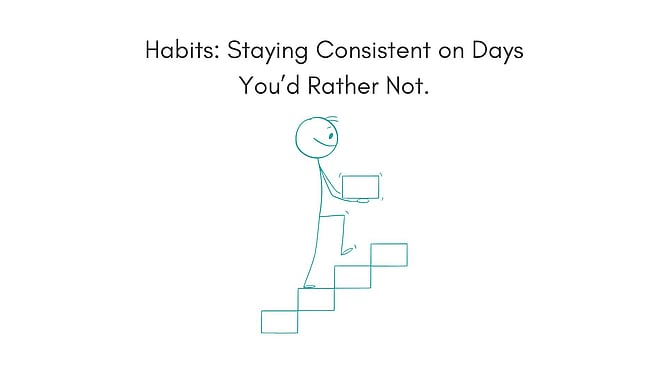
The other day, my brother told me about his grand intentions to ‘lock himself in the library’ to study. Just to be clear, we do not have a personal library - at least last time I checked, there wasn’t one in the family. So he must have been speaking of a public library, which is, by definition, open to the public, including (but not limited to) my little brother - so I doubt that he can actually lock himself in it. What he means, of course, is that he will study so much and for so long that he might as well live at the library for a few days. So far, his very good intentions, right now…
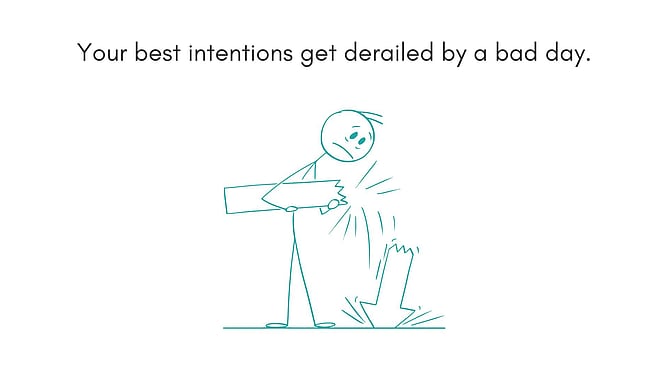
We all have great intentions on our best days. On those days, we follow through on our commitments, we do extra, we stick to established routines, and complete tasks to a high level.
Those days are awesome.
They are also rare.
And as a foundation, they are not sufficient to enable performance. Because they are unreliable.
To reach high performance, we can't rely on a string of good days. We can’t wait for good days so we can do the work or pull off the performance. This is why I think that consistency is one of the most underrated and overlooked skills high performers have.
Rather than waiting for a streak of good days, they establish habits and routines that allow them to do what needs to be done. They show up regardless of how they feel. They do what needs to be done, no matter what the weather is like, whether they're tired, hungry, grumpy, struggling emotionally or are locked in a fight with a loved one or a teammate.
And it's not that everything else should be a second priority.
Instead, high performers have found a way and keep finding ways to consistently do what needs to be done. Even on their worst days.
I was coaching a founding team recently, and we discussed the kinds of routines that might be helpful for them as a team to support their performance long-term. That conversation started with everyone imagining the best possible scenarios, and fair enough, founders are usually both ambitious and optimistic, just like most athletes, which is one of the reasons why I like working with both.
They listed a whole bunch of sophisticated habits and routines they wanted to implement.
So I shifted the perspective and asked, 'What habits can you imagine yourself actually sticking to on your worst day, during your worst week? When everything descends into chaos, when the pressure is on, when you are tired, grumpy, when you feel lonely, or when you are sad?'
Silence.
Then, one of them said, ‘I have never thought of it that way, but it makes sense. If we want to stick to the habit, we need to be able to do it on our worst days.’
Now we had a different conversation. One that wasn’t shaped by bright-eyed and bushy-tailed optimism... but one with awareness that the days will not all be perfect. In fact, most won't be.
What you can consistently do on your worst day becomes your baseline. So place your attention there.
This will become the minimum level of performance that you can reliably deliver. Over and over again. Over time, this level, the quality, will rise. That is what consistency does.
There is a quote popular in fitness circles: ‘The heaviest weight at the gym is the front door.’ It illustrates this beautifully. You can have the best intentions about the workout routine you will stick to. Ultimately, though, you need to get yourself into the gym. So what are the smallest, simplest things you can do to make sure you actually go through that door?
Commit to two things:
putting on your gym clothes every day
spending a minimum of 5 minutes at the gym every day/twice a week/etc.
Chances are, once you are there, you will do a workout. But these two things will get you through the door. So, how do you make sure you do those two things? Here are some ideas:
Block the time in your calendar
Protect that time
Lay out your gym clothes the night before
Pack your gym bag
Make it social - go with a friend (extra accountability) (Don’t use it as an excuse if your friend can’t make it.)
The same works for our founding teams. You want to implement a regular team reflection routine? How can you make sure you get through that reflection door and into it for 5 minutes? If you can do that, you’ll likely continue.
Commit to two things:
Deliberately shifting your perspective from day-to-day to big-picture (work on the team, not just as a team / work on the business, not just in it)
Spending a minimum of 15 min every week/fortnight/month doing that.
Chances are, once you are in this headspace, you will do this more and more thoroughly. But these two things will get you started. So, how do you make sure you do those two things?
Block it in your calendar, regularly
Use the same reflection structure every time so you are not reinventing it every time (eg. what do we want to keep doing, start doing, stop doing?)
Come prepared - take notes as you go & capture what you want to reflect on
Do it together
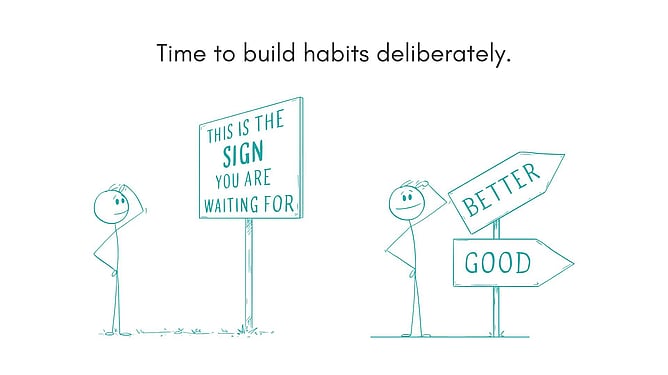
Plan your habits and routines on better days and really think about what will make it easy to stick to on your worst days. What will get you through the door?
There is no magic in high performance. It's basics done well over and over… and over again. Most people can't do that. In a world where random people online have us believe that there is a shortcut to high performance, be consistent.
Do the basic things well. Again. And again. And watch your performance improve.
As for my brother’s study habits, naturally, I’d recommend a more consistent study routine. Shorter blocks over a longer period. More in-depth learning rather than superficial cramming…
But I am his sister after all - so what do I know…
Instead, he changes the topic and tells me I should finally download Strava…
Naturally, like him, I continue my resistance... ;)
Key Points:
Habits and routines help you stay consistent on your worst days.
When designing a new habit, consider what you will actually be able to stick to on your worst days.
Relying on good days is not enough if you want to achieve high performance consistently.
Reflective questions:
What habits do you currently have?
Which ones of them support you to be consistent (in a helpful way) through your worst days?
What could you wrap in a habit to help yourself/your team to be consistent through challenging times?
Key points:
Habits and routines help you stay consistent on your worst days.
When designing a new habit, consider what you will actually be able to stick to on your worst days.
Relying on good days is not enough if you want to achieve high performance consistently.
Reflective questions:
What habits do you currently have?
Which ones of them support you to be consistent (in a helpful way) through your worst days?
What could you wrap in a habit to help yourself/your team to be consistent through challenging times?

