And what does any of this have to do with teams and with coaching?
Some conversations and some questions stay with you long after the moment has passed. This one stayed with me.
That Friday morning, a week before the first Covid Lockdown was announced in New Zealand, I met my friends at a cafe. Then, we did this every Friday. A run followed by a coffee and a catch-up at 7.30 am before work. A ritual that, like so many, was about to be moved online…
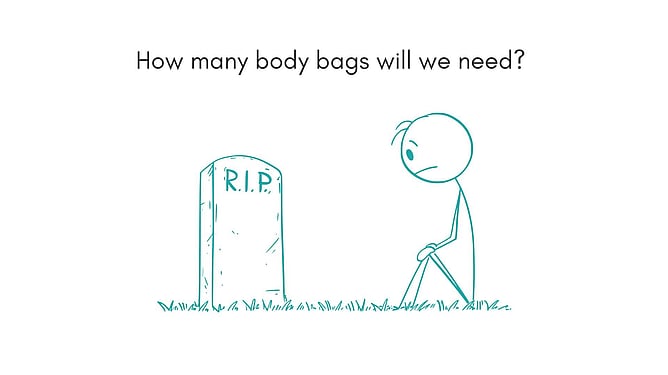
This Friday was different. Gloomier in a way. One of my friends shared a glimpse into her work that week, etc. Working for the government at the time, she said, ‘This week someone asked ‘How many body bags are we going to need?’’ As in, how many body bags would the country need? How many people do we think will die of this? In addition to the usual death rate. How many body bags should we, as a country, order?
It had us in stunned silence. It also conveyed something else:
This is serious.
A couple of days later, the first lockdown was announced, and what followed were several rounds of strict measures to attempt to stop the spread of Covid. To prevent those deaths, New Zealand worked with lockdowns, border closures, social distancing, mandatory mask wearing, a comprehensive vaccination campaign within New Zealand and across its Pacific Island neighbours. In the end, the country had one of the highest vaccination rates and one of the lowest death rates.
I guess that became a kind of answer to this question.
Years later, the same government was heavily criticised for introducing such strict measures, for limiting people’s freedom. Vaccinated or not, those voicing the criticism had likely been protected by the collective and proactive approach, too. Whether they liked it or not. And because of it, they, too, did not end up in one of those body bags.
It may be an extreme example, and perhaps one that some might find controversial. It is, however, also an example of what it means to be proactive, what it means to take preventative action. The trouble, of course, with such things is that, if done well, the worst-case scenario does not eventuate. People don’t die. And thus people don’t see what could have been.
And in this case, it very literally could be worse (IYKYK )
Any prevention is like this. Take health care in general: how often do we hear that a healthy lifestyle, regular exercise and real food contribute to good health, and yet, people take this advice very selectively. Being proactive is actually really difficult, because the problem is not here yet. In a way, you are not trying to solve a problem; you are trying to stop the problem before it even occurs. And that is really difficult to measure, especially in the moment… and convince people of. Because the results and benefits often don’t become visible until years later…
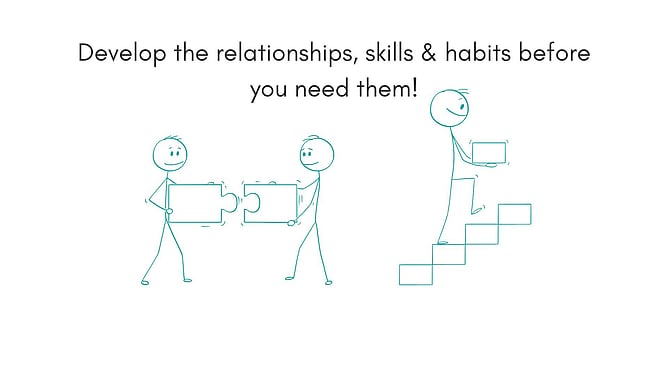
The body bag question and story popped back into my head recently while working with deep-tech startup teams. We help them build the relationships, skills, and habits that enable them to become stronger teams faster. This will help them stay a strong founding team through the ups and downs of the founding journey. As part of this coaching process, we develop the foundations of high-performance behaviours with the intention of enabling the teams to become high-performing long-term.
From Sport, we know that preparation is not optional, that getting ready for challenges and risks is essential and that we need to prepare both as individuals and as a team. In sport, the proactive approach of preparation and prevention does not get questioned. It is part of its fabric.
Often, we hear athletes talk about the choices they are making to set themselves up for success. They talk about their training routines, their planning and reflection, stretching, strength work, and active recovery in an effort to improve performance and lower the risk of injuries. They have understood that preparation is key; that it is part of avoiding injuries, losses, and failures.
Coaching, in general, is perhaps a slightly less grim example (in comparison to body bags at least): Imagine a Premier League or Bundesliga Football Club deciding, ‘Ah, well, let’s not have a coach this year, that’ll save us some money. We’ll just play and see how we go.’ And imagine them once things don’t go so well - which, quite likely they won’t…, Imagine the club saying at this point, ‘Oh wait, we are not winning, and we’re not scoring any goals, it’s not looking too good for us… Well, let’s do a one-day workshop. That should fix it…surely…’
We know, of course, that one, no major league football club would risk this, and that, two, in sport it makes no sense to wait until things go wrong, only to then attempt to fix them after things are broken… with a one-off activity. No chance.
Interestingly enough, we seem fine with this approach elsewhere…
If it’s not broken, don’t fix it seems to be the mentality, only that this often means leaving teams to chance. Until it is too late. Until they break, often to such an extent that they can't be fixed. It is this bit that reminded me of the body bags (took me a while, but I got there in the end… :) ). Because I keep thinking, ‘How many teams are we losing? How many are dying because they don’t work on the team proactively?’
To me, leaving the team to chance is the equivalent of calculating how many body bags we will need, and then doing nothing else to prevent those deaths.
In coaching, we get to work on the team from the start. It is, in a way, an effort to enable them to thrive as much as it is a proactive approach to prevent them from dying. Too many teams fall apart because of co-founder conflicts. It’s not the conflicts themselves that are the problem. In fact, successful teams of any kind should face several different conflicts to build the resilience needed for such a journey. If the relationships within the team are strong enough, a few conflicts help push a few boundaries and will raise performance. If teams don’t spend time deliberately working on themselves, their relationships remain too weak to withstand a few storms. It’s the lack of connection and the lack of skills to navigate such conflicts that pose the real risk.
Prevention and a proactive approach in the context of teams means setting aside time, energy and attention to build the skills that allow them to gain clarity, to build strong relationships, to navigate conflict, to figure out how to make decisions, and so on. This work is needed to avoid the body bag, to avoid the death of a team.
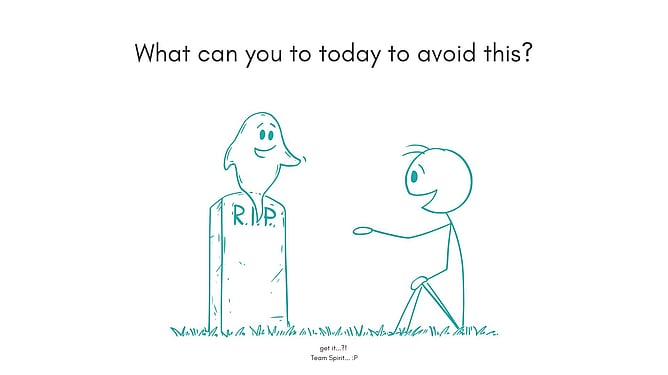
Rather than continuously asking the question, how many founding teams will die this year? I would prefer it if we ask more often, what can we do? What are the skills, and how much time and effort will it take to help teams develop these to prevent their death and enable their success? And how many of them actually know of the risk they are facing? I don’t have an answer yet… but we’re actively trying to figure it out.
It is, of course, much harder to convince someone to spend time, effort and, importantly, money on a problem that has not yet occurred. Coaching doesn’t solve a problem that already exists; it equips you for problems of all kinds that may arise sometime in the future.
Not doing prevention can seem like a cheaper and less time-consuming approach.
That is, until it is not.
No athlete turns up on the Olympic start line with no training… Why would we do this elsewhere?
I don’t know how many body bags New Zealand ordered - and I don’t know how many were actually used (and I would rather not, tbh), only that it was much fewer than it could have been. Because someone dared to say, 'We need to do something early to prevent this.' Because someone insisted on being proactive.
Because some people had that courage and the conviction.
It may be a morbid analogy… but the question remains… What work does your team need to do today to develop the skills that might save it from ending up in a (figurative) body bag later?
Key Points:
You can deliberately build stronger relationships & skills within your team.
Being proactive can feel unnecessary because the results and the advantage may not become visible until much later. Do it anyway!
Coaching is about helping you develop the skills before you need them. Any athlete and sports team knows this!
Reflective Questions:
When have you been proactive, and has it paid off?
When have you not been proactive? What was the result?
Where in your life could you be proactive right now?

