… or how to say Thank You well.
The end of the year is often a time for reflection. Especially the time between Christmas and New Year’s is often a time when people look back at the past year, contemplate what happened, maybe even evaluate, and set goals or make resolutions for the next year. If you have been following this blog for a while, you already know that I am not a massive fan of New Year’s resolutions, but that should not stop you from making them :) And that is also sort of a topic for a different blog.
I am, however, a big fan of saying Thank You properly. And the end of the year, with all its reflection, is a great time to do just that.
A few weeks ago, when I published the blog on TNTs, I already touched on this briefly. After all, it takes no talent to say thank you. You can just do it.
There are different kinds of thank yous, different kinds of appreciation. There is a sort of day-to-day ‘thank you’ when someone holds the door for you, hands you a drink, hands you the receipt, etc. Those little thank yous are important, but they are not the ones I mean here.
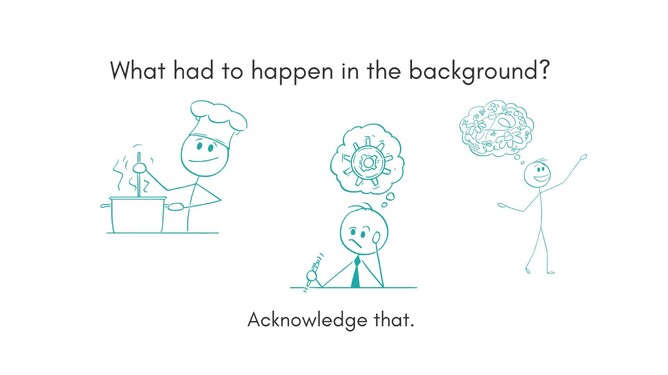
Today, I am more interested in a Thank You that goes deeper, and that is more specific. The kind of thank you that acknowledges the person, their work, the choices they have made, and the time and effort they might have committed to a task. Thank Yous that address what is either taken for granted or that usually remains invisible are the most powerful (at least in my experience).
The appreciation that is most powerful is the one that addresses the work, the effort, the attitude, and the decisions someone had to make in order to do the thing you are thanking them for. By acknowledging that, you are making explicit that they had a different choice. They could not have done this; they could have spent their time differently, they could have applied themselves with less effort or conviction. They could have been less committed. They had a choice. They chose to do it this way. Thanking people for that, making visible (at least in your words) that you noticed how they showed up, matters.
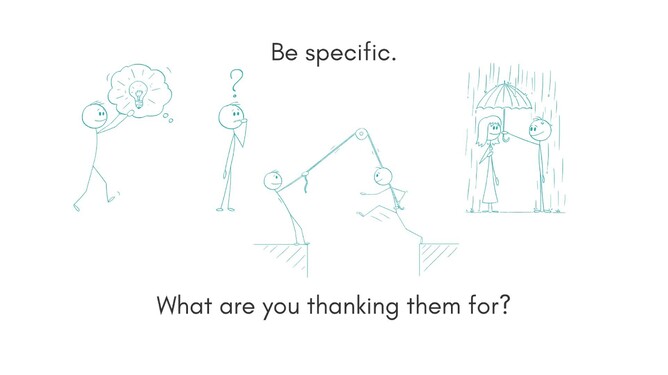
For example, with Christmas coming up, you might thank the family member(s) who are hosting Christmas this year for the time and thought they have put into preparing. Maybe they have been the ones who coordinated who needs to bring what or who arrives when. All of this is additional thinking load or mental work required to make it work. If someone did this for you, say thank you. Be specific, eg.:
Thank you for hosting Christmas this year. We value that you put time and thought into this because we realise that you did this in addition to everything else that needed to be organised at the end of the year, and we are grateful you took the time to do this so we can all spend this time together. …
You might have a friend who supported you this year or who went out of their way to cheer you up or who contributed by planning a trip, etc. Take five minutes to thank them beyond those two words.
Thank you for putting so much effort into planning our trip to <...>. It was one of my favourite times this year, and it wouldn’t have been so easy if you hadn’t done so much planning and organising. Really appreciate you taking the time, it made a big difference to all our experiences. …
You might have had people at work who helped you throughout the year, or people you worked on a project with who supported you or who made a difference to how that work went. Or maybe they supported you with a personal challenge, and they were there for you on tough days while you were at work. Tell them.
Thank you for helping me out with <XYZ>. Knowing I have you in my corner truly made a difference to my time at work. I appreciate that we can have a laugh and that we can also put our heads together and get work done. My experience at work wouldn’t have been the same without you. …
Naturally, my examples above are a little generic. Make yours as specific as possible to the person you are thanking.
You are considering it, but it feels weird?
Well, yeah. Many people are not used to expressing genuine, specific, and personal thanks like this. We often stop at the Thank You or the Well Done, etc. If you are not used to expressing appreciation, it might feel weird to you.
Do it anyway.
And then do it again.
You’ll get better at it, and it will feel less weird.
But what if the other person is also not used to it?
Well… maybe it’s time we all start practising :)
I really don’t think expressing true appreciation has any downsides. I do think it is important that you mean it, that you genuinely want to thank that person and that you are not doing it for your own benefit, or to be seen as someone grateful, but because you actually are grateful. Use that as your filter. Because people will know if it’s not genuine. Do it to elevate them
Also, just to not leave that out: sometimes you can also show appreciation in small gestures, a nod, a smile when someone has something for you, a picture or meme of something you know the person will find funny, sharing treats you know the person likes, etc. All that says, I see you, I value you, I am thinking of you, and I appreciate you. Try it sometime.
The bonus, of course, is that expressing gratitude makes you feel good, too. Though again, that should not be the main reason to do it.
Ok, enough talk about appreciation: go and do it now. Tell someone how they have made a positive difference to your life lately. Or maybe write a Thank You note (or three) before Christmas. They could be a card, an email, a DM, a txt, a voice note. Whatever works for you.
And, just because it feels appropriate to end on a Thank You Note: Thank you, my readers, for taking the time to read this post and so many of the other ones. This is only a very small little blog and it does actually mean a lot to me that you guys are reading it. It also always makes me smile when someone messages to say they liked the blog this week, so thank you for that, too. To my NZ peeps, I miss you, but I am always happy to hear from you and see your lovely summer pictures. Sending a big Thank You from this side of the world and looking forward to chatting with some of you soon. Have a great Christmas. I’ll likely be back with a new blog mid-January, though there will be a couple of re-posted ones in between.
Thank you, merry Christmas & lots of love
Key Points:
Appreciation is especially effective when it is specific and personalised.
Expressing it does not cost you anything.
Showing gratitude and appreciation will make you feel better too.
Reflective Questions:
When have you last thanked someone for something specific, acknowledging the invisible work/effort/sacrifice they have made in order to do the thing you are thanking them for.
If you were to thank three people before Christmas, who would it be and what would you thank them for?
Once you have done it, how do you feel? :)

